
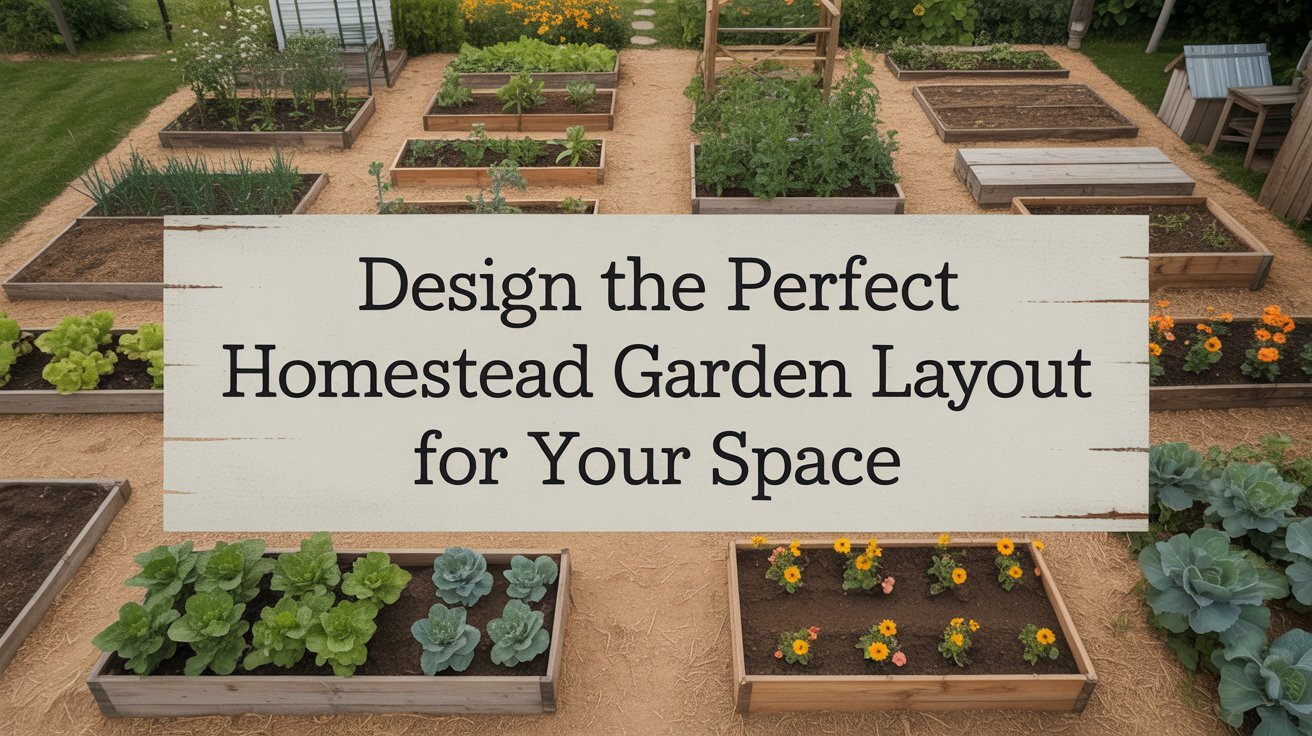

Growing your own food feels good, but doing it on a bigger scale takes planning. When you design a smart homestead garden layout, you set yourself up for success from spring through fall and beyond.
A good plan means you’ll have fresh vegetables when you need them. It also helps you grow enough to store for the winter months. This guide will show you how to plan a garden that feeds your family all year long.
You’ll learn about different layout options, how many plants you really need, and ways to make the most of your space. We’ll cover simple methods that work for beginners and experienced growers alike.
What Makes a Homestead Garden Layout Different

A homestead garden is bigger than a backyard vegetable patch. The goal is clear: grow enough food to feed your family for months, not just weeks. This means thinking about storage crops like potatoes, onions, and winter squash alongside your fresh eating vegetables.
Most homestead gardens range from a quarter acre to several acres. They focus on plants that produce a lot of food and store well. You’ll grow more or fewer varieties instead of tiny amounts of everything.
The layout often uses traditional in-ground rows rather than small raised beds. This makes sense when you need 100 tomato plants instead of 10.
Your paths need to fit a wheelbarrow, and your rows need to be long enough to make weeding and watering efficient.
Three Proven Homestead Garden Layouts

Here are three tested homestead garden layout options. Pick the one that fits your space and goals, or mix ideas from each.
Layout Example 1: Compact Homestead (40′ x 30′)
This layout works great if you’re just starting. It gives you 1,200 square feet to work with, which is enough space to grow food for 2 to 4 people.
The design uses 8 to 10 rows running the length of the garden. Leave 2-foot paths between rows for easy access.
Plant your tall crops like tomatoes and beans on the north side so they don’t shade shorter plants. Put quick-growing crops like lettuce and radishes on the south end.
Layout Example 2: Square Foot Approach (50′ x 50′)
This setup gives you 2,500 square feet and works well for growing many different crops. You can fit all the major vegetable families with room for extras.
Break the space into zones by plant type. Group heavy feeders like tomatoes and squash together.
Put root vegetables in another section. This makes crop rotation easier next year. Add 3-foot paths every 15 feet so you can reach the middle of each section without stepping on soil.
Layout Example 3: Production Scale Layout (50′ x 93′)
When you’re serious about growing most of your food, this larger homestead garden layout delivers. At nearly 4,700 square feet, it can feed a family of 6 to 8 people year-round.
Use long rows with 3-foot spacing for most crops. This gives you room to work but doesn’t waste space.
Put perennials like asparagus and berries along one edge where they won’t interfere with tilling. Run rows north to south when possible for even sun exposure. Keep a 4-foot path down the middle for bringing in compost and hauling out harvest.
Remember, you can adapt any of these layouts to fit your actual space. The key is having enough room for the crops you eat the most.
Calculating Plant Quantities for Your Family

Guessing how many plants to grow leads to waste or shortages. Instead, think about what your family actually eats and how much you want to preserve.
A family of six needs about 120 potato plants for a year’s supply, assuming each person eats potatoes twice a week. For fresh eating through summer, plan on 37 tomato plants. That sounds like a lot, but it includes plants for sauce making, too. Onions are easy to calculate: 200 plants give you about 150 pounds if each bulb weighs three-quarters of a pound.
For vegetables you’ll preserve, grow 54 green bean plants for a good freezer stock. Six cucumber plants will give you enough for fresh eating and some pickles.
Start with these numbers, then adjust based on how much your family actually eats. Always lean toward growing more of what stores well, like potatoes, garlic, and winter squash.
Smart Space Saving Techniques

You can grow more food in less space with a few simple tricks. These methods let you use every inch of your homestead garden layout without making it complicated.
Succession Planting
Don’t let garden space sit empty after early crops finish. Plant lettuce in March, then put beans in that same spot in June. After beans finish in August, plant fall crops like broccoli or carrots.
Quick-growing crops like radishes and lettuce can go in 2 or 3 times per season. This gives you fresh salad greens from April through October instead of just one big harvest.
Mark planting dates on a calendar so you remember when to start the next round.
Interplanting Strategies
Some crops grow well together in the same space. Plant lettuce between tomato plants in May. The lettuce will be done before the tomatoes get big enough to shade it out.
Put fast growers like radishes between slow ones like carrots. The radishes will be ready to eat in 30 days, while carrots take 70 days. This works because radishes break up the soil as they grow, which actually helps the carrots. You harvest twice from the same row.
Using Additional Areas
Not everything needs to go inside the main garden fence. Garlic grows fine outside the fence since animals don’t bother it much. Plant flowers for cutting along the outside edge, too.
Use containers on a patio for herbs and lettuce when the main garden fills up. Add trellises or stakes for cucumbers and pole beans.
They’ll grow up instead of spreading across the ground, saving you several square feet per plant.
Crop Rotation for Long-Term Success

Moving crops to different spots each year keeps your soil healthy and reduces pest problems. This practice, called crop rotation, is simple but important for a productive homestead garden layout.
Plant families should move to a new location every year. Tomatoes, peppers, and potatoes are all in the same family. If tomatoes grew in row 3 this year, plant something different there next year. This breaks pest cycles because bugs that winter in the soil won’t find their favorite food when spring comes.
A basic rotation works on a 3 to 4-year cycle. Divide your garden into sections. This year, put heavy feeders in section A, root crops in section B, and light feeders in section C.
Next year, shift everything over one section. Keep notes on paper or your phone about what grew where. You’ll forget by next season if you don’t write it down.
Tips for Implementing Your Homestead Garden Layout

Getting your homestead garden layout right the first time saves work later. Here are practical tips that make a real difference.
Start with less space than you think you need if this is your first big garden. It’s better to grow a smaller area well than to plant too much and get overwhelmed.
You can always expand next year.
- Plan a dedicated space for starting seedlings. A small greenhouse or cold frame lets you grow your own transplants and keeps production going.
- Make paths at least 2 feet wide. You’ll thank yourself when you need to push a wheelbarrow full of compost or harvest through the garden.
- Think about water before you plant anything. Running hoses across paths gets old fast. Set up a simple drip line or plan where sprinklers will reach.
- Leave extra space somewhere for future expansion. Your garden will probably grow as you get more confident.
- Mark where the permanent plants will go first. Asparagus, rhubarb, and berry bushes stay in one place for years.
- Draw everything on paper before you dig. Use graph paper to keep the scale accurate. One square can equal one foot.
- Watch where the sun and shade fall at different times of day. What gets full sun in June might be partly shaded in September.
These steps take an extra day or two at the start. But they prevent mistakes that take years to fix.
Conclusion
A successful homestead garden layout starts with good planning. Think about how much food your family needs, what grows well in your area, and how much time you can spend maintaining everything.
Balance big goals with practical limits. It’s fine to start smaller and build up over a few seasons. Your first garden teaches you what works on your specific land.
Use the layout ideas here as a starting point. Change them to fit your space, climate, and family’s eating habits. Good planning now leads to full pantries and freezers later.
Grab some paper today and start sketching. Mark your garden size, note where the sun hits longest, and list the crops you eat most. Your future self will appreciate the effort when harvest season arrives.
Frequently Asked Questions
How Much Fencing Do I Need for a Homestead Garden?
Measure the perimeter of your garden and add 10% extra. For deer protection, use 7 to 8-foot-tall fencing. Rabbit fencing only needs to be 3 feet high with 6 inches buried underground.
Can I Start a Homestead Garden on Less Than a Quarter Acre?
Yes, but you’ll need to focus on high-value crops and use intensive methods. A well-planned 1,000 square foot garden can still produce a lot of food. Grow what your family eats most and skip space-hungry crops like corn.
When Should I Start Planning My Homestead Garden Layout?
Winter is ideal for planning since you can’t work the soil anyway. Start in January or February. This gives you time to order seeds, build beds, and make changes to your plan before spring planting starts.
What Soil Preparation Is Needed Before Creating a Homestead Garden?
Test your soil first to know what it needs. Most gardens benefit from added compost or aged manure. Clay soil needs organic matter to loosen it. Sandy soil needs compost to hold moisture. Build fertility over time rather than trying to fix everything at once.
Do I Need Special Equipment to Maintain a Homestead Garden?
Basic tools like a spade, rake, hoe, and wheelbarrow handle most tasks. A tiller helps for larger spaces, but isn’t required. As your garden grows, you might want a push seeder and wheel hoe. Scale your tools to match your garden size and budget.


